Restaurant Inventory Management: How to Cut Waste, Control COGS, and Improve Margins
Restaurant Inventory Management: Best Practices, SOPs, and Tech for 2026 Learn how restaurant inventory management works in 2026, including FIFO/FEFO, par levels, cycle counts, POS integration, SOPs, and KPI tracking to reduce waste and improve margins.
Restaurant inventory management used to mean a weekly count and a hopeful order. In 2024–2026, the winners run inventory like a living system: POS-connected usage, tighter par levels, smarter rotation (FIFO/FEFO), and real-time checks that catch waste and risk before it hits the plate. With food costs volatile, labor tight, and safety expectations rising, even small gains in portion control, receiving accuracy, and forecasting can move profitability fast. This guide breaks down the fundamentals, the methods that actually work on a busy line, and the tech stack—plus step-by-step SOPs—so you can turn inventory into a repeatable margin engine.
What is restaurant inventory management?
Restaurant inventory management is the system restaurants use to track what they have, what they should have based on sales and recipes, and what they need to buy next without hurting service.
It covers processes, tools, and daily habits that keep a live, accurate picture of what you actually have on hand across food, beverage, paper goods, and chemicals. It also shows what you should have based on POS data, recipes, and purchasing records.
In plain English, the 2026 version is not just “doing inventory.” It is receiving discipline, storage discipline, counting discipline, and purchasing discipline, supported by software that ties POS, recipes, on-hand counts, and ordering together so the numbers stay useful between counts.
Why is this urgent now? Operators are dealing with margin pressure from labor, input costs, and volatility. Net profit is often in the single digits, so a 1–2% COGS swing matters a lot. If you net about 3–5%, a 2% rise in COGS can wipe out roughly 40–67% of profit on the same sales. Elevated labor costs were also identified as a major drag on profitability in 2024.
Terms people mix up, and why that breaks ordering:
On-hand is what is physically there right now. Par is the target amount you want after ordering. Safety stock is your backup buffer for spikes or disruptions, and it is not the same as par. Theoretical inventory or usage is what the system says you should have or should have used from POS data and recipes. Usable inventory is what you can actually sell, meaning not expired, spilled, or mislabeled. Units also matter. “1 case” versus “12 each” versus “4/1 gal” can create fake variance and bad cost rolls if you do not standardize.
COGS that connects to real life: COGS = Beginning Inventory + Purchases +/−Transfers − Ending Inventory. If ending inventory is wrong because of a bad count, wrong unit, missed invoice, or unlogged credit, your COGS is wrong. Then you end up adjusting menu prices, prep pars, and orders using bad math. That is how restaurants talk themselves into cutting a profitable item or over-ordering a weak one.
Cause-and-effect chain managers can use:
Receiving mistakes such as shorts, wrong pack sizes, or invoices not entered lead to wrong on-hand numbers. That leads to wrong suggested orders, which causes overstock or stockouts, then spoilage or 86s, then higher COGS and lower guest satisfaction.
Trend snapshot for 2025–2026: the shift is moving from spreadsheet-based periodic counts to integrated POS, inventory, and purchasing systems with real-time or near-real-time depletion and tighter invoice capture. Early AI is showing up in forecasting and anomaly detection, such as sudden spikes in a high-theft SKU or recipe mapping errors. Error and waste reductions are often reported in case studies, but mobile counting and tighter workflows regularly show fewer discrepancies when teams catch issues faster.
What KPIs should restaurants track first?
Start with COGS, waste, variance, stockouts, and your top-spend SKUs. These five measures show where money is leaking and where controls will have the biggest effect first.
- COGS % for food and bar separately
- Waste % or waste dollars per week, plus the top 10 wasted SKUs
- Variance dollars by category, actual versus theoretical
- Stockouts per week, including every 86 that affects a guest
- Top 20 SKUs by spend so you focus controls where money really moves
How often should restaurants take inventory?
Weekly counts are common for tighter control, and many teams add weekly key-item counts plus a fuller count on a regular schedule to catch problems earlier.
Weekly inventory is common in restaurants that want better control, while many teams also count key items more often and run a full count on a set cadence.
What is a good inventory turnover for a restaurant?
A good turnover rate depends on your concept, menu, and perishability, but most restaurants aim for faster turns so food moves before it spoils.
Turnover is usually tracked as COGS divided by average inventory, and targets vary by business model and shelf life.
Why do restaurants have variance when on-hand counts look fine?
Variance can still happen when recipes, units, waste logs, and receiving records are wrong, even if the shelf count looks normal at first glance.
Recipe mapping gaps, unit conversion errors, unlogged waste, comps, staff meals, receiving mistakes, and over-portioning can all create “normal sales, abnormal usage”.
Do restaurants need real-time inventory to win?
No. Real-time inventory is helpful, but clean processes and strong integration matter more because they reduce re-entry and help teams catch problems faster.
You do not need real-time inventory to succeed, but integration reduces manual work and shortens the time between a mistake and a fix.
What should restaurants standardize first in inventory?
Standardize units and pack sizes first. If purchasing, recipes, and counts use different units, every report becomes harder to trust.
Start with each, pound, case, and pack-size consistency across purchasing, recipes, and counts. If units are not aligned, variance and cost reports quickly become unreliable.
What inventory methods actually reduce waste and variance?
The best methods are simple: rotate stock correctly, set realistic pars, count often enough to catch errors, and separate expected variance from preventable variance.
Rotation that survives a slammed service: use FIFO for dry goods and frozen items, and switch to FEFO for short-life products like dairy, cut produce, and prepped sauces. FEFO reduces spoilage, but only when teams are strict about date labels and placing new product behind older product. Make it easy to follow with shelves zoned by category, a left-to-right use-first flow, and clear front-edge labels that show item name, prep or open date, and discard date.
How should restaurants set par levels and reorder points?
Set par using average daily usage, lead time, and safety stock. This gives you enough product to stay in stock without carrying too much extra inventory.
Par = average daily usage × lead time + safety stock. Example: if chicken thighs sell at 12 pounds per day, lead time is 2 days, and safety stock is 1 day, then par is (12 × 2) + 12 = 36 pounds. Raise pars for promos or catering, and add safety stock when vendors become less reliable.
Should restaurants use full counts or cycle counts?
Most restaurants should use both. Full counts give a complete picture, while cycle counts catch issues faster and with less disruption during normal operations.
Full counts are accurate but disruptive. Cycle counts can catch problems faster with less pain. A practical cadence is weekly full counts for smaller operations, daily A-item spot checks plus weekly cycle counts for bigger kitchens, and a monthly deep audit.
How should restaurants investigate inventory variance?
Start with recipe mapping and POS data, then check receiving and invoices, then review portions, waste logs, and yields. This order finds the most common causes first.
Separate expected variance, like yield loss, comps, and staff meals, from unexpected variance, like mis-rings, over-portioning, receiving errors, or theft. Begin with POS mix and recipe mapping, then review receiving and invoices, then check portion tools and waste logs because actual versus theoretical food cost depends on standardized recipes and portions.
Track yields using EP ÷ AP × 100 on proteins and produce so trim loss and cooking loss do not show up as mystery shrink.
- Best practices checklist: FEFO labels on dairy, produce, and sauces; cooler zones; pars reviewed weekly; receiving check and signoff; daily top-10 SKU spot check; weekly cycle count; protein weights at prep; scoops, ladles, and scales on the line; waste logged by reason; variance reviewed by category.
- Common mistakes: counting in different units; not updating recipes after substitutions; ignoring transfers and returns; estimated receiving; labeling prepped items without discard dates; and setting pars once and never updating them.
What restaurant inventory tech stack works best in 2026?
The best tech stack starts with clean POS integration, live recipe costing, better receiving controls, and dashboards for variance, waste, and stockouts before adding more advanced tools.
Tech only helps if it closes an operations gap. Start with POS to inventory depletion. Sales should automatically consume ingredients, including modifiers, combos, and prep items, but only if your item and recipe mapping is disciplined. Sloppy mapping creates phantom variance and weak forecasts.
Next, recipe costing and menu profitability should update when invoice prices change so you catch margin drops quickly, not at the end of the month. For purchasing and receiving, digital POs, invoice capture, and approvals reduce missed credits and payment mismatches.
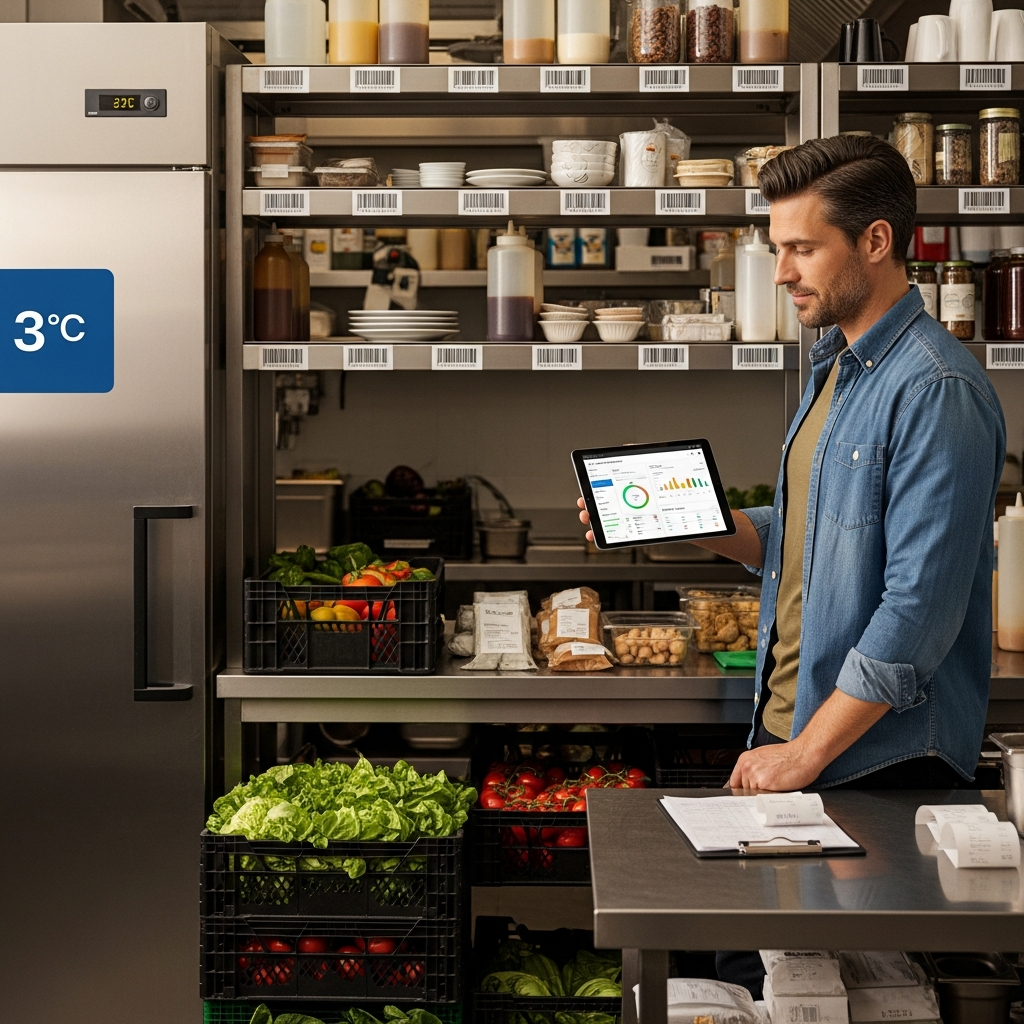
In working kitchens, QR or barcode labels and mobile counts can make counts faster if you use one standard naming rule, such as Location–Zone–Item–Pack–Date. IoT temperature sensors can pay off by logging continuously and alerting teams before product is lost, which supports HACCP-style monitoring and records.
AI is useful for demand forecasting, suggested orders, anomaly detection, and spoilage-risk flags, and restaurants are increasing tech investment heading into 2026. But AI is only as good as your units, receiving accuracy, and POS mapping.
Direct priority list: prioritize (1) clean POS integration and audit trail, (2) live recipe costing from invoices, (3) purchasing and receiving controls, (4) variance, waste, and stockout dashboards, and (5) open APIs to accounting and vendors.
- Selection scorecard: integrations, phone usability, implementation support, reporting depth, offline mode, permissions, audit logs, and total cost.
- Vendor questions: How do you map modifiers and combos? Can we lock a master catalog? How do you handle refunds and voids? Do invoices update recipe costs automatically? What is the approval workflow? How does offline mode work? Are there API limits? What role permissions exist? How are multi-unit transfers handled? Can data export to the accounting chart of accounts? Who owns the data? What are your support SLAs?
What SOPs keep restaurant inventory accurate every day?
The best SOPs turn inventory into a calendar. Teams should spot-check key items daily, cycle count them weekly, and run full counts and audit recounts every month.
Make the SOP a calendar, not a binder. Use daily 5–10 minute spot checks on pain-point SKUs like proteins, dairy, and liquor. Use weekly cycle counts for those items, and a monthly full count plus one audit recount aisle to catch pattern errors.
What is the best receiving and put-away SOP for restaurants?
A strong receiving SOP checks the PO, counts product, checks temperatures and quality, records credits, labels items, and stores them using FEFO right away.
Receiving and put-away, step by step:
- Match the delivery to the PO.
- Count the units.
- Temperature-check TCS foods at receiving.
- Check quality, including damage and odor.
- Note substitutions and request credits.
- Label with item name, prep or open date, and use-by date.
- Store using FEFO, and keep cold holding at 41°F/5°C or below.
What should restaurants log at open and close?
At open, check the line and flag any 86 risks. At close, log waste and cooler temperatures so problems are documented and easier to fix.
Use an opening line check and an “86 risk” list. Close with waste capture for prep waste, spoilage, overproduction, returns, and comps, plus a quick cooler temperature log because if it is not logged, it did not happen.
- Receiving checklist: count, temperature, quality, label, and invoice or PO notes.
- Counting sheet rules: fixed units, same shelf order, photos for odd packs, and lock counts after submission.
- Variance log: item, expected versus actual, root cause, fix, owner, and due date.
How can restaurants reduce theft and improve controls?
Separate duties, run surprise counts, and review high-risk items more closely. Basic control steps often reduce theft more than extra software alone.
Purchaser should not be the same person as receiver or invoice approver. This basic segregation of duties strengthens internal controls. Surprise counts and camera-backed audits on high-theft items can also help.
What food safety and compliance rules matter most for inventory?
Date marking, temperature control, and traceability matter most. If product is not labeled, held correctly, and traceable, it creates both safety risk and waste risk.
Date-mark ready-to-eat TCS foods and do not hold them longer than 7 days. For traceability, keep lot and Key Data Elements tied to Critical Tracking Events for listed foods.
One-page manager checklist: temperatures logged, top-SKU spot check done, receiving errors and credits filed, waste entered, and one variance action assigned.
Quick FAQ: How do you reduce theft? Separate duties and run surprise counts. What are the must-have receiving checks? Count, temperature, label, and credit notes.
How do restaurants improve inventory ROI over 30, 60, and 90 days?
Start by tracking the right KPIs, tightening vendor and invoice controls, then improving recipe costs and pars before rolling out new technology more widely.
Vendor strategy is margin strategy. Start with a simple supplier scorecard that tracks price, lead time, fill rate, substitutions, quality consistency, minimums, and delivery windows. Review it monthly so preferred-vendor status is earned, not inherited. Negotiate with levers you can actually control, such as tighter order cadence, volume tiers, split deliveries, short fixed-price windows, and a clear credits and returns policy.
To stop quiet leakage, use a three-way match. Approve payment only when the PO, receiving record, and invoice all match. This is also a simple accounts payable control that helps prevent errors and overbilling.
The money loop should track COGS percentage, inventory turnover, waste and shrink, stockouts, order accuracy, and purchase price variance or PPV on a weekly dashboard. Then run PDCA, which stands for plan, do, check, adjust, on one driver at a time.
Use inventory and recipe costing to support menu engineering. Update plate costs ingredient by ingredient, then raise price, adjust portion size, or reduce slow SKUs through better cross-use. For patterns, not promises, one multi-location operator reported about a 3% COGS drop after tightening inventory and purchasing workflows, and industry guidance connects tech-enabled inventory control to cost savings and waste reduction.
- 30 days: baseline KPIs, a PPV watchlist, and a top-20 SKU focus.
- 60 days: pars and reorder points, recipe cost cleanup, and a vendor scorecard review.
- 90 days: pilot integrations, validate ROI, and standardize what worked.
What should restaurants do next to improve inventory fast?
Start with a simple dashboard, tighten invoice controls, refresh recipe costs, cut slow SKUs, and run one improvement test each week.
- Publish a one-page weekly KPI dashboard.
- Implement three-way match on every invoice.
- Refresh recipe costs monthly.
- Cut or merge 10% of low-velocity SKUs through cross-use.
- Renegotiate using fill-rate and substitution data.
- Run one PDCA experiment each week.
What is the main takeaway on restaurant inventory management?
Great inventory control comes from consistency, visibility, and fast feedback. When restaurants standardize, count well, and fix issues quickly, waste drops and margins improve.
Great inventory is not about fancy spreadsheets. It is about consistency, visibility, and fast feedback. When you standardize recipes and portions, rotate stock with FIFO and FEFO, set realistic pars, and count the right items on the right schedule, your COGS becomes more predictable and waste drops.
Add modern tools such as POS integrations, barcode workflows, and, where it fits, AI forecasting and IoT temperature logs, and you can reduce stockouts, spoilage, and mystery variance. Start with baseline KPIs, fix receiving and storage first, then pilot tech for 90 days on critical SKUs. Done well, inventory management becomes a daily habit that protects food safety and steadily grows margins.
https://www.youtube.com/watch?v=DdOcLRIZNWM
For assistance or support with restaurant Accounting, Operations, HR & Payroll, Taxes, Compliance, or other related tasks in your restaurant locations, contact FORCS. They are certified experts in R365 and professional Accounting and Operations Support!